Wednesday, July 1, 2015

My Ancestry Back to My Great-Grandparents

Ahnentafel format:

1 Kenneth Leroy HORN [That's me; this list also works for my two sisters]

PARENTS
2 Leroy Kenneth Earl HORN b. April 4, 1910, Douglas Co. near Girdner, Missouri; d. May 30, 1991, Richmond, Contra Costa Co., California[1]
m. 9/2/1933 Richmond, Contra Costa Co., California
3 Adeline [Rose Adelaide] COREY b. July 19, 1908, Hill Crest (now Daly City), California; d. Jan. 17, 1994, San Pablo, Contra Costa Co., CA[2]
GRANDPARENTS
4 Frank Eugene Horn b. Nov. 9, 1882, Shenandoah, Fremont/Page Co., Iowa; d. July 8, 1960, Pleasant Hill, Contra Costa Co., California[3]
[m1.: Anna Schmidt 9/20/1903 Watonga, Blaine Co., OK][4]
m2. [BCW] 7/29/1908 Watonga, Blaine Co., OK
5 Bessie Cleo Wharton b. 10/19/1889[5] Bosworth, Carroll County, Mo.; d. 3/15/1971, Martinez, Contra Costa Co., CA
6 Earl Councilman Corey b. Aug. 15, 1888[6] or 1889[7] Omaha, Nebraska; d. Mar 21, 1967[8] Santa Clara, CA[9]
m1. [MEM] Aug. 9, 1907, San Francisco, CA; divorced after 1930[10]
[m2. Harriet Venable Barker [Her m1 to Uddenberg] Dec. 6, 1934, San Benito, CA (b. 1/2/1891, CA; d. 2/17/1983, Santa Clara, CA)][11]
7 Mary (Mamie) Ellen Mylon b. Dec. 25, 1888, San Francisco, CA; d. June 26, 1978, San Pablo, Contra Costa Co., CA[12]

GREAT-GRANDPARENTS
8 John Henry Franklin Horn b. Aug. 12, 1861, Allentown, Lehigh Co., PA; d. Sept. 30, 1953, Yuma Rural, Yuma Co., Arizona[13]
m. [JMF] 1/12/1882, Sidney, Fremont Co., Iowa[14]
[m2. 1893[15] Anna Elizabeth Ward Haffey (b. 11/23/1856- d. 9/5/1925), Madison Co., Mississippi]
9 Jennie May (Jane) Fishbaugh b. June 22, 1862[16], Tiffin, Seneca Co., Ohio; d. 
July 7, 1890, Anthony, Harper Co., Kansas
10 William M. Wharton b. Jan. 1859, Ypsilanti, Washtenaw Co., Michigan; d. Frederick, Tillman Co., Oklahoma[17]
m. Aug. 4, 1885, Carroll Co., Missouri[18]
11 Susan “Susie” Frances Addis b. Mar. 1860, Carroll Co, Missouri; d. between 1920-1930[19]
12 Seth Ambrose Corey b. May 13, 1863, Illinois; d. Jan. 21, 1929, San Francisco, CA[20]
m1. [AC] Nov. 4, 1886, Omaha, Douglas Co., Nebraska[21]
m2. Elizabeth A. Unknown (1877-1945), after June 1909
13 Amanda Adeline or Adelaide “Addie” Councilman b. Nov. 1856, Welton, Clinton, Iowa, or July 1857, Iowa[22]; d. June 1909
14 Thomas J. Mylon[23] b. Nov. 4, c.1849, Roscommon, Ireland[24]; d. June 17, 1912, San Francisco, Calif.[25]
m. 1887, St. Patrick’s Church, San Francisco, CA.
15 Rose Ann Conlon b. June 22, 1870[26], Dublin, Ireland[27] d. Dec. 12, 1930[28]


[1] Birth, death and marriage documents.
[2] Birth, death and marriage documents.
[3] Buried Memory Gardens, Concord, Contra Costa Co., California.
 Obits., etc.
[4] (lic. date 9/18)
[5] (birth cert.; 1900 census says Sept., wrong); ; bur. Memory Gardens, Concord, CA
[6] (1942 draft card)
[7] (1917 draft card & death certif.)
[8] (death index)
[9] [SS# 545095363]
[10] Wedding License: 8/19/1907, with consent of Earl Corey’s father. Marriage Certif. (same doc.): 8/9/1907 (one date typo?). City and county of San Francisco.
Witnesses: Bessie Corey 22 Byington Ave.
            S.A. Corey --
[11] SS# 545095362
[12] Obituary. Buried in Sunset View Cemetery, El Cerrito, CA. Cemetery incorrectly listed as Berkeley in at least one obituary. Photograph of headstone by KLH.
[13] (death certif.); ; bap. 1861 Jordan Reformed Church, Allentown, PA
[14] [Fishbaugh Bible]
[15]  Ancestry.com family trees.
[16]  [6/22/1861 in Fishbaugh Bible]
[17]  1870, 1880, 1900, 1910, 1930 censuses [June Standley has d. Manitou, Tillman County, Oklahoma]; bur. Oklahoma. Middle initial poss. W.?
[18] Missouri Marriages 1750-1920 Index
[19] Censuses. (She’s on 1920 census but William is “widowed” on the 1930 census.) Addis & Bright Family Tree claims Death 5 Apr 1940 in Bosworth, Carroll, Missouri, but no doc and it disagrees w/ census.
[20] Funeral record and FindAGrave [Nov. 1860, Ohio in 1900 census. See problems.]
1910 Census
San Francisco
Ten years after 1900 census, Seth has a second wife, Elizabeth A. (did Addie die?), Earl C. is out of the household (he was the oldest); there are 2 new children, George & Myrtle. The 4 holdover children from the 1900 census have the same names and are all 10 years older, so these are definitely the same kids.
But here’s the problem. A bunch of info is different from the 1900 census:
Seth should be 50; but he’s 44. His parents are listed as from Ireland and Mass. (instead of both Ohio). His birthplace is listed as Illinois, instead of Ohio. The four holdover kids are listed as born in Wisconsin (instead of Washington), as is George. Myrtle was born in Calif.
They are living in San Francisco, which is where Earl Corey and Mary Ellen Mylon met and married.
1920 census lists Seth (53 from Illinois) & Elizabeth (42 from CA) in San Francisco w/ 2 daughters, Myrtle (13) and Phebe (7).
….
Possible: Birth 1862 in Spring Rock, Clinton, Iowa
Death 1929 [http://trees.ancestry.com/tree/68798403/person/36191716314 Parents = Gideon C. & Mary Robts. No spouse or children listed.]
Find A Grave Memorial# 21284791 has Seth A. Corey b. May 13, 1863, Illinois; d. Jan. 21, 1929, California. Bur. Woodlawn Memorial Park, Colma, San Mateo County, California
With Elizabeth A. 1877-1945
[21] Actual marriage record says: "Seth A. Corey, Addie Councilmann [double N is prob. a typo], Nov. 4, 1886, First Methodist Church, Omaha, Douglas, Nebraska." The 1900 census says they've been married 13 years, which is correct. They had not yet reached their 14th anniversary when the census was taken.
1900 Census
Fairhaven, Whatcom, Washington
Corey Seth A: head, b. Nov. 1860, age 31 [bad math; would be 40], m. 13 years, b. Ohio, mother b. Ohio, father b. Ohio, occupation” police man, owned house (mortgaged)
Corey Addie: wife, b. Jul. 1851, age 42 [bad math; would be 49], m. 13 years, mother of 5 children, all living, b. Iowa, mother b. New York, father b. New York
Children:
Earl C b. Aug. 1888, age 11, b. Nebraska
Bessie A b. Sep. 1891, age 8, b. Washington
Grace B b. Jan. 1894, age 6, b. Washington
Frank S b. Aug. 1895, age 4, b. Washington
Ross T b. June 1897, age 2, b. Washington
[22]  [1900 census] [AMANDA A., born Nov., 1856; died June, 1909.]
[23] Ellene Horn Reagan’s written notes from interview with Mary Mylon Corey list his name as John Thomas; other records reverse that. His name on gravestone is Thomas (see Find A Grave Memorial# 95957251). His son was named John Thomas.
[24] Place listed on all four of his military enlistment/discharge papers.
[25] Buried 
San Francisco National Cemetery: census and Find A Grave Memorial# 95957251. Fought in Indian Wars. His copies of service papers burned in San Francisco Quake and Fire, according to Ellene Horn Reagan’s written notes from interview with Mary Mylon Corey. His pictures were with Mary Corey’s sister Anne.
[26] (funeral rec.)
[27]  Immigrated 1874. This and her birthplace from Ellene Horn Reagan’s written notes from interview with Mary Mylon Corey.
[28] Following operation for appendicitis, she died of “ether pneumonia,” according to doctor’s statement.

Sunday, June 21, 2015

Happy Father's Day

This is my dad's 25th Father's Day in Heaven. I've missed him for a long time. Both of my sisters are with him today. (I miss them too.) The pic shows the three of them together. Grateful for a Godly father who left many positive memories behind him.

Saturday, June 20, 2015

Bad Old King John

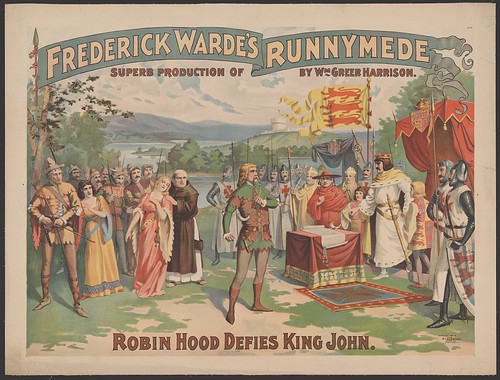
800 years ago this week my ancestor signed one of the most important documents in world history. But he is definitely not to be admired. And I guarantee you are familiar with him.
A World Without Robin Hood? 800th Anniversary of Magna Carta
On June 15, 1215, King John met 40 rebellious barons in a field at Runnymede. He gave in to their demands to stave off a civil war, affixing his seal to Magna Carta.
These barons confronted a tyrant in order to protect their rights and property. Principles within the document have been passed down to democratic nations, such as:
"No freeman shall be taken, imprisoned, disseised, outlawed, banished, or in any way destroyed, nor will We proceed against or prosecute him, except by the lawful judgment of his peers or by the law of the land."
"To no one will We sell, to no one will We deny or delay, right or justice."

Magna Carta has been stamped into our Constitution and our Bill of Rights. The Fifth Amendment to the Constitution displays its mark: "No person shall . . . be deprived of life, liberty, or property, without due process of law.”

So, yes, I have a famous ancestor, good old villainous King John. But even if you spaced out on Magna Carta in history class, you still should know him. Everyone should be familiar with a genre that has given him much exposure through the years—the Robin Hood tales. Yes, my great-gramps (x25) is the bad guy in Robin Hood, the one to whom the sheriff of Nottingham answers, Prince John.

But 800 years ago, he won the barons’ approval. And, shock of shocks, while he changed his mind later and the document was nullified, it was reissued through the years and has given today’s democracies their character.


My 25 x great-gramps was a bad guy. But it was precisely because he was so bad that Magna Carta was drafted. And, if you’re not grateful for that, just remember—without him there probably would never have been a Robin Hood. And who can imagine a world without Robin Hood?

Thursday, February 5, 2015

A Simple Mathematical Way to Track Family Trees: The Ahnentafel

Family trees become incredibly unwieldy as one adds generations, doubling size in height on the chart with each generation. The Ahnentafel, or Ahnen List, is a great alternative, keeping trees in linear form. One simply needs to remember some simple math formulas:

Whoever is the individual whose tree is being charted receives the number 1. Then, to find anyone’s father’s number, double number of child. Mother is doubled plus 1. Thus, their father is 2, their mother is 3. To reverse this and find someone’s child’s number, divide father’s number by 2; or mother minus 1, then divided by 2.

Algebraically:

 F = 2C

 M = 2C + 1

 C = F/2

 C = (M - 1)/2

This is the system I will use when I begin to publish my Horn Family Tree. To illustrate, in brief, from my tree:

 1 Kenneth Leroy HORN

 PARENTS

 2 Leroy Kenneth Earl HORN

 3 Rose Adelaide COREY

 GRANDPARENTS

 4 Frank Eugene Horn

 5 Bessie Cleo Wharton

 6 Earl Councilman Corey

 7 Mary Ellen Mylon

One then adds basic info to each numbered individual: birth and death dates and places. Marriage date and place. Footnotes are added for sources and miscellaneous explanation. The system sounds difficult to some, but is really quite easy to use.

Tuesday, December 23, 2014

Hanukkah Part 4

Hanukkah will end when the sun goes down tomorrow. Gifts are indeed given during Hanukkah, but usually these are to children, and may often be gifts of money or Hanukkah “gelt.” The gelt giving also usually extends to the needy. Because it is the miracle of the oil that the celebration recognizes, it is customary to have foods fried in oil. Some eat latkes, or fried potato pancakes, while others eat deep-fried doughnuts. The toy and game most associated with Hanukkah is the dreidel, a top with 4 sides. Each side has a letter of the Hebrew alphabet; together the letters form an acronym. There are two different forms of the top, with only the fourth letter varying. In Israel, the dreidel represents Nes gadol haya po, “A great miracle happened here.” Outside of Israel it is Nes gadol hayah sham, “A great miracle happened there.” Well, Hanukkah is almost over. It does have a significance to Christians. I like to think of it as a reminder that the Jews are God’s chosen people and while, in a spiritual sense, Christians become His chosen people (see 1 Peter 2:9), God still loves and has a plan for Israel. The Bible tells us there is coming a time when “all Israel will be saved” (Romans 11:26). And that is how we should pray. Happy Hanukkah.

Sunday, December 21, 2014

Hanukkah Part 3

Hanukkah is an 8-day celebration but this year it falls between Dec. 16 and 24. Isn’t that 9 days? No. Jewish days begin at sunset. So their first day was the evening of Dec. 16 and throughout the daylight hours of Dec. 24. Today, the 20th, is the 4th day, which started last night. The final day begins the night of the 23rd and ends on the 24th at sundown. The ceremony revolves around the menorah. On each evening of Hanukkah the number of candles corresponding to the number of the day are lit. One on the first day, 2 on the second and so forth, until the 8th day. Then 8 candles are lit as well as the central candle, the shamash (“servant” candle). Hanukkah evenings that fall on Friday have a slight change. Since it is the beginning of the Sabbath, and no fire is to be lit on the Sabbath, the candles are lit slightly before sundown. Tomorrow's final entry includes a few miscellaneous facts.

Saturday, December 20, 2014

Hanukkah Part 2

Hanukkah celebrates the victory of a far outnumbered group of Jews known as the Maccabees over the powerful Greek occupiers of the Holy Land in the second century B.C. It is called the Festival of Lights because of the miracle that took place when they rededicated the Second Temple after it had been defiled by the Greek leader Antiochus Epiphanes, who desecrated the Temple by sacrificing a pig on the altar. A small but fervent army was raised beginning in the small village of Modin and led by a priest, Mattathias, and his sons, who refused the edict to worship Greek gods. The outmanned group, also called Hasmoneans, spearheaded a victory over their persecutors and recaptured the Holy City of Jerusalem. Now the desecrated place of worship needed to be cleansed and rededicated. But the Jews could not find a supply of oil undefiled by the Greeks sufficient to keep the menorah (9-branched candelabrum) burning for more the one night. Miraculously, that small supply of oil burned for eight days. By then a fresh supply of oil for the menorah had been prepared. The festival commemorates this with daily candle lightings, thus it is called the Festival of Lights. Next: How Hanukkah is celebrated.

Friday, December 19, 2014

Hanukkah Part 1

Happy Hanukkah! Have you heard this and not really known what it means? Hanukkah (also spelled Chanukah) is an 8-day celebration that falls around Christmas time. The reason the date is movable is that it is based on the Hebrew calendar, beginning on the 25th of Kislev. The Hebrew calendar is lunar (related to the moon) and thus Hanukkah can fall anywhere between November 28th and December 26th. This year it falls between December 16 and 24. That means it is already in full swing. It is not a major holiday in the Jewish culture but it does have quite an elaborate set of traditions associated with it, and it does have a significant origin. While its origin is not biblical like most Jewish holidays, it is indeed mentioned in the Bible. The event it commemorates fell between the Old and New Testaments, thus the surprising fact that this strictly Jewish celebration is found only in the New Testament. The word Hanukkah means “dedication” and it is mentioned in a key passage in the gospel of John, one in which Jesus makes a clear claim to deity. John 10:22-31 (NIV): “Then came the Feast of Dedication [Chanukah] at Jerusalem. It was winter, and Jesus was in the temple area walking in Solomon’s Colonnade. The Jews gathered around him, saying, ‘How long will you keep us in suspense? If you are the Christ, tell us plainly.’ Jesus answered, ‘I did tell you, but you do not believe. The miracles I do in my Father’s name speak for me, but you do not believe because you are not my sheep. My sheep listen to my voice; I know them, and they follow me. I give them eternal life, and they shall never perish; no one can snatch them out of my hand. My Father, who has given them to me, is greater than all; no one can snatch them out of my Father’s hand. I and the Father are one.’ “Again the Jews picked up stones to stone him ….” Jesus’ mention of miracles fits with the Hanukkah theme. In the next post we’ll look at the meaning of the celebration — what it commemorates — and learn why it is also called the festival of lights.

Friday, November 21, 2014

The Mayflower Compact 1620

By Jean Leon Gerome Ferris (1863-1930). On November 21 in 1620 (or Nov. 11 under the Julian calendar they used then), my ancestor William White, along with other adult male passengers of the Mayflower, signed the Mayflower Compact, adapting language that was used for church charter in Netherlands after the Puritans fled persecution in England. William and his wife became the parents of the first child born in the new world, Peregrine White, from whom I am descended. My ancestor William, however, did not have long to appreciate this new land, dying three months later during that harsh first winter that killed nearly one-half of the "pilgrims" who made the voyage. Note on the painting from the Library of Congress: "The artist, Jean Leon Gerome Ferris, depicts how he thinks passengers of the Mayflower looked signing the 'Mayflower Compact.' Included are Carver, Winston, Alden, Myles Standish, Howland, Bradford, Allerton, and Fuller. Starting in the early 20th century, Ferris created a series of commemorative interpretations of early American development called 'The Pageant of a Nation.'"