Saturday, May 21, 2016

Travesty of Galileo's Imprisonment

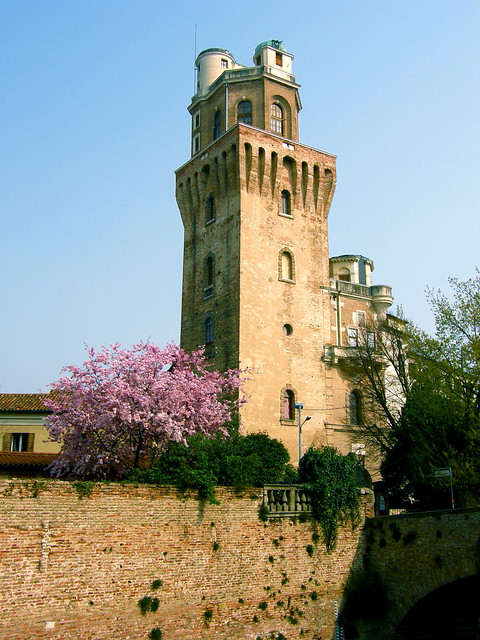
Galileo's Astronomic Observatory Tower, PaduaIn 2007 I first saw Galieo's Asronomic Observatory at Padua (Padova) University in Italy. It was here in the early 17th century that he observed 4 moons revolving around Jupiter, using a super-powerful telescope that he had invented. The telescope also enabled him to make several other amazing discoveries. Far from impressed, the other professors refused to even look through it, since Galileo felt, by analogy, this confirmed Copernicus' teaching that the earth revolved around the sun, not the other way around as the Catholic church taught. (Ecclesiastes 1:5 says, "The sun riseth, and goeth down, and returneth to his place: and there rising again.") Though he moved to Florence to seek a freer intellectual climate, the "church" soon caught up with him and threatened to place him on trial for heresy. He stayed quiet for years, but when he published his book on astronomy, the Inquisition arrested and imprisoned him, threatening him with torture if he didn't recant his view about the sun. To save his life, he recanted, but was still branded a heretic and placed under house arrest ... for the rest of his life. The Catholic church's brutal repression of science and its use of torture in the Inquisition are two of many historical evidences showing what a wonderful thing it was that genuine Christianity had begun to find its own way in the Reformation of the previous century ... becoming Protestantism. Next year it will be 500 years since that momentous occurrence began in Wittenberg, Germany in October 1517.
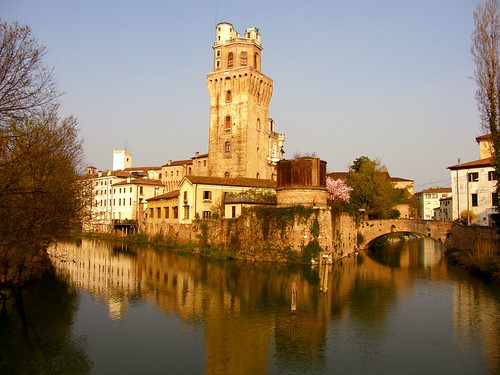
Galileo's Astronomic Observatory, Padua, Italy
[Photos by Ken Horn]

Monday, May 16, 2016

J. Roswell Flower: A Brief Biography by David Ringer (Wipf & Stock, 2016) Reviewed by Ken Horn

It has long been said that the Assemblies of God is unlike other religious movements in that it doesn’t have a single founder, one major personality with whom it is identified who exerted the most substantial influence at the birth of the movement and helped mold it into a form that would be enduring.

If we were to search for such an individual, J. Roswell Flower would clearly emerge as a strong candidate, all the more impressive because he exerted the influence without ever holding the Fellowship’s highest office. Beginning at the inaugural meeting in 1914, he served in national office multiple times, as district superintendent in the Eastern District, and many, many more. (Of course this reviewer is most impressed with the fact that he was founder, publisher, editor of the magazine that became the Pentecostal Evangel, the official publication of the Assemblies of God for a century.)

Although much has been written about Flower, David K. Ringer has provided the first biography of this giant of Pentecost. The book is signally important in at least two ways:

1.   It introduces Flower to a new generation. J. Roswell, his wife, Alice Reynolds Flower, and the Flower family have an enduring heritage in the Assemblies of God. Indeed, the archives of the Fellowship have been dubbed the Flower Pentecostal Heritage Center. But young ministers, workers and attendees of AG churches need this introduction. At 128 pages, this brief biography is eminently readable. Churches would do well to encourage their people to read the book, and get copies for their church libraries. In a day when many Assemblies seem to be minimizing and, thus, forgetting our heritage, this book can provide a crucial connection to a past that can inspire the present.

2.   It is based on an unprecedented wealth of research. The book is based on Ringer’s 2014 D.Min. project for Assemblies of God Theological Seminary. That in turn is partially based on the Flower Family Papers, a collection for which Ringer, who married one of Flower’s granddaughters (Kathryn Flower Ringer), enjoyed unsurpassed access. His family connection also allowed him to undergird the book with unique personal insight.

Flower’s life and words call our movement to be faithful to the vision of our founders. "I have not forgotten the early days of our Pentecostal movement,” he is quoted in the book. “There was an earnest desire to separate from all the things of the world. There was no particular need to frown on worldliness in dress and deportment, for the very passion to please God was sufficient to bring separation from these things" (p. 89).


It is this reviewer’s hope that the book will enjoy a wide circulation, and that its contents will inform, but more importantly, spiritually inspire many a reader.

Wednesday, April 27, 2016

An Interesting Will in the Corey (Cory, Corrie) History in Portsmouth, Rhode Island

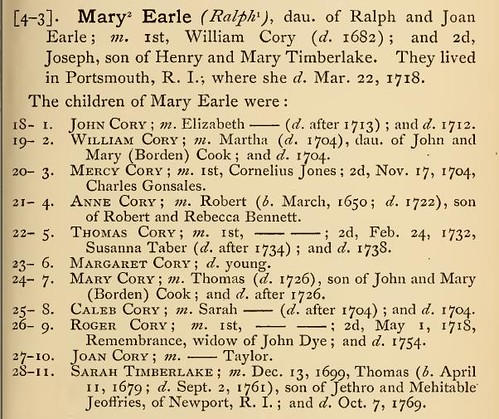
My eight-great-grandmother Mary Earle (1640-1718) lived her entire life in Portsmouth, Newport Co., Rhode Island. She had two husbands, the first being my ancestor William Corey (or Cory). They wed c. 1655 and William died in 1681. Mary's second marriage was c. 1683 to Joseph Timberlake. He passed in 1693. Just 53 when she was widowed the second time, she lived the last quarter century of her life as a widow.

Thus she died at an advanced age of about 78 years old, far beyond the life expectancy at the time. Her will dated Aug. 12, 1717, bequeaths portions of her estate to many children, in-laws and grandchildren. She had 11 children (10 Corey, 1 Timberlake), four of which predeceased her.
Mary Earle in Famiy Book
She gave significant (if modest) bequeaths to most of the family, but she gave an unusual (and humorous) gift to her son-in-law:

"I give and bequeath to my son in law Charles Gonzales Moreno the five cords of wood that he owes me."

That was it. That unpaid wood kept him from getting a larger share of the estate! Lesson: Don't get on the wrong side of your mother-in-law. (However, his wife received a good portion.)

There was another interesting bequeath. Mary had an Indian girl as an indentured servant. I have found no evidence that any of my ancestors owned a slave, and this is my first knowledge of a servant. They are, of course, much different things. This was bequeathed to her one Timberlake child. The will states:

"I give and bequeath unto my daughter Sarah Jeffries the term of years I have in my Indian girl Dina, she performing covenants according to Indenture."

Two interesting entries.

Saturday, April 23, 2016

Miguel de Cervantes 400-Year Anniversary

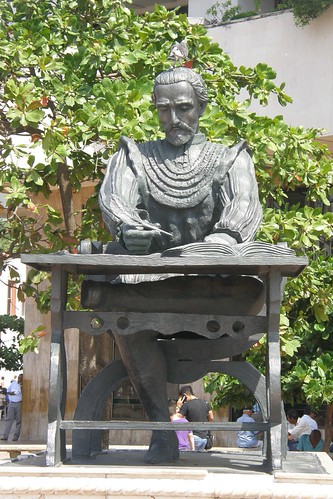
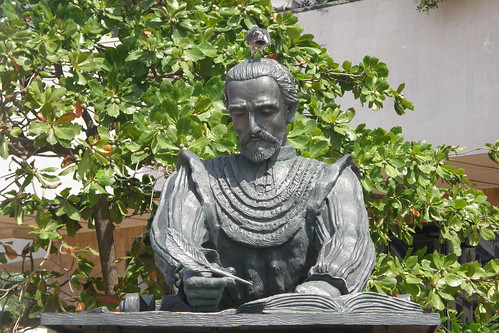
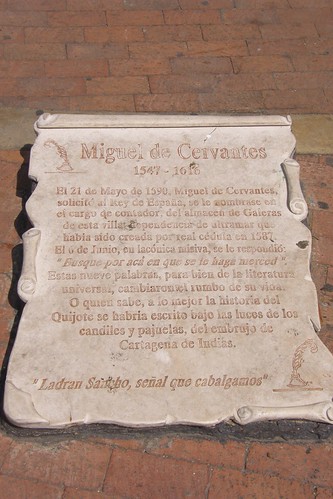
Friday, the 22nd was the 400th anniversary of the death of Miguel de Cervantes, Spain's best known author. The country celebrated Cervantes today, the anniversary of his burial. While most of the world is recognizing the 400th anniversary of William Shakespeare's death today, Spain and many Spanish-speaking countries are celebrating Cervantes, whose best known work is Don Quixote. We encountered this intricate statue of Cervantes in Cartagena, Colombia, in 2012. Miguel de Cervantes at His Desk, Pen in Hand
Miguel de Cervantes, Author of Don Quixote
Miguel de Cervantes 1547-1616

Sunday, April 17, 2016

This Day in Horn Family History: "Old Raven" Dies


My seventh-great-grandfather Wilhelm Kraft Rabenold [alternate spellings Rabennalt, Rabenalt, etc.] died this day in about 1749 in Lowhill Township, Northampton Co, PA [1]. My No. 568 ancestor was born Dec. 15, 1698, in Ichstedt, Germany. [2]

He married Maria Magdalena Bauer on May 30, 1730, in St. George's Chapel, Lichtenburg, Germany. [3] They Immigrated to America on the ship Samuel, landing in Philadelphia on August 30, 1730.

Descent:


284 Johann(es) Peter Rabenold/t b. 1728, Lichtenberg, Germany; d. 1807, Northampton County, PA.

142 Peter Rabenold b. 1754; d. 1828, Whitehall Township, Lehigh County, PA.

71 Susanna Rabenold b. Oct. 28, 1782, ‪Lowhill Township, ‪Northampton County, ‪PA; d. January 20, 1853, South Whitehall Township, Lehigh County, PA.

35 Anna (or Hannah) Koch b. Mar. 14, 1815, Macungie, Lehigh Co., Pennsylvania (or Whitehall Township, Lehigh, PA); d. after 1838.

17 Mary Ann Meitzler b. Aug. 7, 1835, near Allentown, PA; d. 10/7/1910, Tiffin or “south of Tiffin,” Seneca Co., OH.

8 John Henry Franklin Horn b. Aug. 12, 1861, Allentown, Lehigh Co., PA; d. Sept. 30, 1953, Yuma Rural, Yuma Co., Arizona.

4 Frank Eugene Horn b. Nov. 9, 1882, Shenandoah, Fremont/Page Co., Iowa; d. July 8, 1960, Pleasant Hill, Contra Costa Co., California.


My dad: 2 Leroy Kenneth Earl Horn b. April 4, 1910, Douglas Co. near Girdner, Missouri; d. May 30, 1991, Richmond, Contra Costa Co., California.

[1]Book: The Descendants of Wilhelm Kraft Rabennalt & Maria Magdalena Bauer Rabennalt "Old Raven", 1698-1998 by Jessie D. & Benjamin J. Raubenolt, New Image Graphics, 1998 - 270 pages.
[2] Transcript of German birth certificate.
[3] Book: The Descendants of Wilhelm Kraft Rabennalt & Maria Magdalena Bauer Rabennalt "Old Raven", 1698-1998 by Jessie D. & Benjamin J. Raubenolt, New Image Graphics, 1998 - 270 pages.
Immigration: 30 Aug 1730, To Philadelphia on Ship Samuel. — Ancestors of Franklin Phillip Stahl354 — Jesse Dean Raubenolt, II, Research of Jesse Raubenolt,(E-mail dated May 5, 1999), "Electronic."