For Christ did not send me to baptize but to preach the gospel, and not with words of eloquent wisdom, lest the cross of Christ be emptied of its power. — 1 Co 1:17
Friday, March 29, 2019
1 Cor. 1:17


Friday, March 15, 2019
This Date in a WW2 Diary
"Sun. Mar. 15/42
Cecil and I went to Cinco de Junio for Meetings. Heavy gunfire coming from Corregidor. A fighter plane, flying low over Manila, let a few bursts go from its machine gun and wounded a few people in Paco. Last week I went to the Red Cross. One of the women there in charge was a fellow student of mine at the University of California. We had quite a chat. They could not do much for us, but this friend of mine made arrangements whereby we got some groceries, rice, sugar, cracked wheat, and a few canned goods."
— From Deliverance! It has Come! by Missionary Herman Knight Beaber who spent three years as a prisoner of war under the Japanese in the Philippines.
Saturday, November 24, 2018
Grandfather's Chair: Nathaniel Hawthorne Tells Mary Dyer’s Story
Nathaniel Hawthorne was born in 1804 in Salem, Massachusetts. He became one of the most renowned authors of the nineteenth century. A friend to fellow writers and transcendentalists Henry David Thoreau, Ralph Waldo Emerson, and Louisa May Alcott, their shared philosophy sometimes colored his writing.
But his writing was more influenced by Salem.
He was embarrassed by his strange hometown that was so branded by its past. So he moved away in 1850 never to return—except in his writing. And there he returned repeatedly.
Hawthorne’s embarrassment went beyond Salem the place. Indeed he felt a personal responsibility; his own family had had a hand in its most regrettable incidents. His ancestor William Hathorne had sat in judgment of persecuted Quakers and that ancestor’s son, John, had been a magistrate sitting as judge at the Salem Witch Trials.
Thus, Hawthorne’s writings (most notably The Scarlet Letter) sometimes attempt to atone for the errors of his family’s past by calling attention to Puritan leaders’ failings.
Such is the case with one of his least known books. Often this book is not even to be found in the listings of his writings. It’s a remarkable volume, written for children, that tells the story of New England through the fictionalized journeys of a single chair. The full title of the book is The Whole History Of Grandfather's Chair or True Stories From New England History, 1620-1808. It was first published in 1841.
Our interest in this book, Grandfather's Chair for short, is that, in its pages we find the story of Mary Dyer, my ninth-great-grandmother. It is that tale that follows (the text is in the public domain):
WHEN his little audience next assembled round the chair, Grandfather gave them a doleful history of the Quaker persecution, which began in 1656, and raged for about three years in Massachusetts.
He told them how, in the first place, twelve of the converts of George Fox, the first Quaker in the world, had come over from England. They seemed to be impelled by an earnest love for the souls of men, and a pure desire to make known what they considered a revelation from Heaven. But the rulers looked upon them as plotting the downfall of all government and religion. They were banished from the colony. In a little while, however, not only the first twelve had returned, but a multitude of other Quakers had come to rebuke the rulers and to preach against the priests and steeple-houses.
Grandfather described the hatred and scorn with which these enthusiasts were received. They were thrown into dungeons; they were beaten with many stripes, women as well as men; they were driven forth into the wilderness, and left to the tender mercies of wild beasts and Indians. The children were amazed to hear that the more the Quakers were scourged, and imprisoned, and banished, the more did the sect increase, both by the influx of strangers and by converts from among the Puritans. But Grandfather told them that God had put something into the soul of man, which always turned the cruelties of the persecutor to naught.
He went on to relate that, in 1659, two Quakers, named William Robinson and Marmaduke Stephenson, were hanged at Boston. A woman had been sentenced to die with them, but was reprieved on condition of her leaving the colony. Her name was Mary Dyer. In the year 1660 she returned to Boston, although she knew death awaited her there; and, if Grandfather had been correctly informed, an incident had then taken place which connects her with our story. This Mary Dyer had entered the mint-master's dwelling, clothed in sackcloth and ashes, and seated herself in our great chair with a sort of dignity and state. Then she proceeded to deliver what she called a message from Heaven, but in the midst of it they dragged her to prison.
"And was she executed?" asked Laurence.
"She was," said Grandfather.
"Grandfather," cried Charley, clinching his fist, "I would have fought for that poor Quaker woman!"
"Ah, but if a sword had been drawn for her," said Laurence, "it would have taken away all the beauty of her death."
It seemed as if hardly any of the preceding stories had thrown such an interest around Grandfather's chair as did the fact that the poor, persecuted, wandering Quaker woman had rested in it for a moment. The children were so much excited that Grandfather found it necessary to bring his account of the persecution to a close.
"In 1660, the same year in which Mary Dyer was executed," said he, "Charles II was restored to the throne of his fathers. This king had many vices; but he would not permit blood to be shed, under pretense of religion, in any part of his dominions. The Quakers in England told him what had been done to their brethren in Massachusetts; and he sent orders to Governor Endicott to forbear all such proceedings in future. And so ended the Quaker persecution—one of the most mournful passages in the history of our forefathers."
Thursday, November 15, 2018
Monday, August 13, 2018
Thursday, August 9, 2018
Friday, August 3, 2018
Monday, May 21, 2018
This Day, May 21, in Horn-Corey Family History
May 21, 1660 Mary Dyer, my 9th-great-grandmother, is arrested and jailed in Boston for the last time, leading to her execution 11 days later. Her crime? Returning to Boston after she had been told to stay out. She defied the ban to comfort fellow Quakers who had been imprisoned under harsh conditions.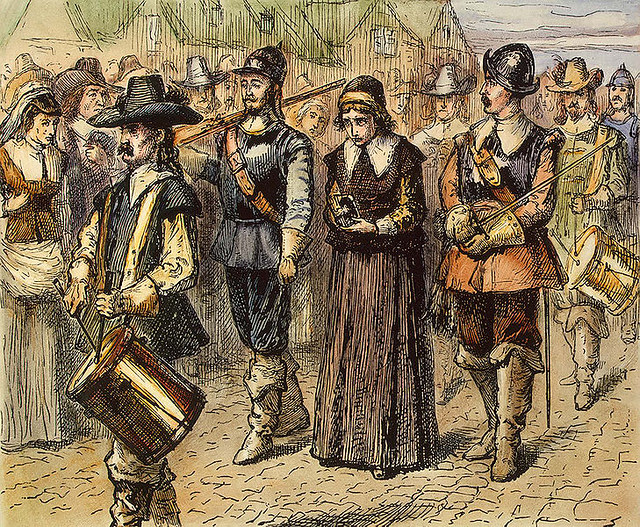 "Mary Dyer led to execution on Boston Common, 1 June 1660" (public domain, unknown artist)
May 21, 1669, Samuel Dyer, son of William & Mary Dyer and my 8th-great-grandfather (he married Anne Hutchinson, the granddaughter of Anne Marbury Hutchinson) is made Conservator of the Peace at Kingstown, RI.
May 21, 1820 Aucelia Ann [Angeline] Horton [27 2g] is born in Hector, Schuyler County, New York
"Mary Dyer led to execution on Boston Common, 1 June 1660" (public domain, unknown artist)
May 21, 1669, Samuel Dyer, son of William & Mary Dyer and my 8th-great-grandfather (he married Anne Hutchinson, the granddaughter of Anne Marbury Hutchinson) is made Conservator of the Peace at Kingstown, RI.
May 21, 1820 Aucelia Ann [Angeline] Horton [27 2g] is born in Hector, Schuyler County, New York
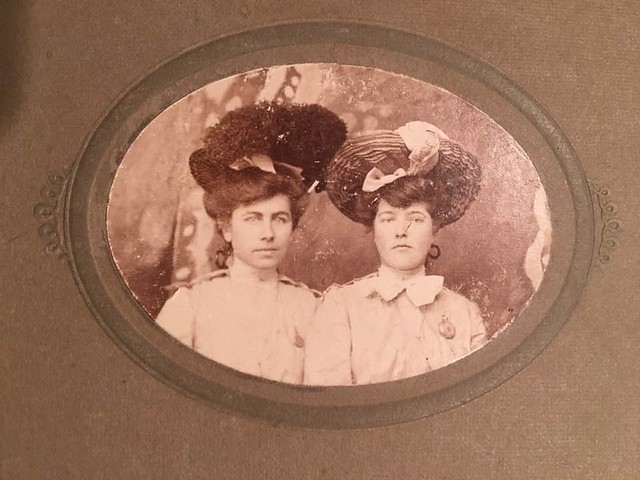 May 21, 1885 Nellie May Horn, grandaunt, sister of grandfather Frank Horn, is born. Nellie is on the left.
"Mary Dyer led to execution on Boston Common, 1 June 1660" (public domain, unknown artist)
May 21, 1669, Samuel Dyer, son of William & Mary Dyer and my 8th-great-grandfather (he married Anne Hutchinson, the granddaughter of Anne Marbury Hutchinson) is made Conservator of the Peace at Kingstown, RI.
May 21, 1820 Aucelia Ann [Angeline] Horton [27 2g] is born in Hector, Schuyler County, New York
May 21, 1885 Nellie May Horn, grandaunt, sister of grandfather Frank Horn, is born. Nellie is on the left.
Saturday, May 19, 2018
This Day, May 19, in Horn-Corey Family History
The world considers May 19 a special day this year because it is the day that Prince Harry married Meghan Markle, which happened just a few hours ago as I type this. But there are other important occurrences this date, connected to our family.
On May 19, 1973, Kenneth Leroy Horn (that’s me) and Peggy Louise Paul married in Concord, Contra Costa Co., California, at Full Gospel Church. Yes, today is our 45th anniversary.
On May 19, 1643, the New England Confederation is founded, joining the colonies of Plymouth, Connecticut, New Haven and Massachusetts Bay in a military alliance against the threats of Native Americans, the French and the Dutch. This confederation was significant to our ancestral families who lived in Plymouth and Massachusetts Bay—the Whites, Winslows, Hutchinsons & Dyers.
In 1305, our ancestor Count William the Good of Hainault married Jeanne De Valois. They are our 22nd great-grandparents.
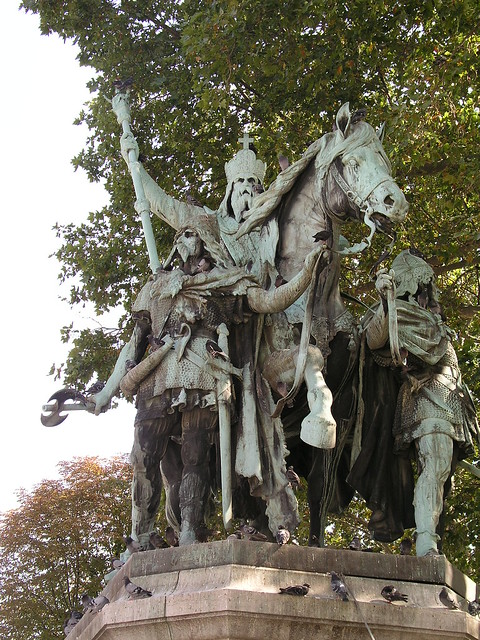 And way back in 804 “Alcuin of York, an English scholar who became an adviser to Charlemagne and the most prominent figure in the Carolingian Renaissance (the rebirth of classical learning under Charlemagne), die[d]. He also devised a handwriting system using both small and capital letters for easier reading.” —This Day in Church History, Christianity Today.
King Charlemagne (Charles the Great) is my 38th great-grandfather. (Photo taken by me in the plaza of Notre Dame Cathedral.)
And way back in 804 “Alcuin of York, an English scholar who became an adviser to Charlemagne and the most prominent figure in the Carolingian Renaissance (the rebirth of classical learning under Charlemagne), die[d]. He also devised a handwriting system using both small and capital letters for easier reading.” —This Day in Church History, Christianity Today.
King Charlemagne (Charles the Great) is my 38th great-grandfather. (Photo taken by me in the plaza of Notre Dame Cathedral.)
And way back in 804 “Alcuin of York, an English scholar who became an adviser to Charlemagne and the most prominent figure in the Carolingian Renaissance (the rebirth of classical learning under Charlemagne), die[d]. He also devised a handwriting system using both small and capital letters for easier reading.” —This Day in Church History, Christianity Today.
King Charlemagne (Charles the Great) is my 38th great-grandfather. (Photo taken by me in the plaza of Notre Dame Cathedral.)
Friday, May 18, 2018
British Loyalists Flee to Canada Following the Revolutionary War, Including Some of My Ancestors
I love history and genealogy. Here’s a bit of both concerning this date in history.
It had been one of history’s most surprising upsets. The underdog, upstart American Colonists had recently stunned the mighty British Empire and won their freedom. For those who had not supported the revolutionaries, there was upheaval.
 On May 18, 1783, the British transport ship Union docked with the fleet transporting the first group of United Empire Loyalists to leave the newly created United States of America for friendlier British territories. These “Tories”—those faithful to the British Crown during the 8-year American Revolutionary War—had forfeited their land and much of their possessions to the victorious American Patriots (called Rebels, Traitors, or worse by the British). Most Loyalists ended up in nearby Canada, the first of them debarking at Parrtown, Saint John, Nova Scotia, which is now New Brunswick.
My ancestor Gideon Corey was among those aboard the Union.
It had been just 3 months since the War for Independence had been ended with the signing of the Treaty of Paris. Throughout most of the War, New York had been under British control, and this was where the majority of Loyalist evacuees were from.
The Crown repaid their loyalty by granting them land in unsettled regions. They became pioneers in the area of Nova Scotia that became New Brunswick one year after their arrival.
Gideon Corey, born in Rhode Island, was just 19 when the Colonies officially declared their Independence and 26 (and single) when he became a Canadian resident.
He soon married Abigail Clarke. Abigail’s ancestor Joseph Clarke is my eighth-great-grandfather. It is his brother, John Clarke (1609-1676), who is a significant historical figure. He was a medical doctor and founding pastor of the First Baptist church in Providence, as well as co-founder of Rhode Island and author of its groundbreaking charter. The charter asserted “that no person within the said colony, at any time hereafter shall be any wise molested [harassed], punished, disquieted, or called in question, for any differences in opinion in matters of religion, and do not actually disturb the civil peace of our said colony.” But Abigail was of a different political inclination than her famous relative.
Gideon and Abigail Corey, my fourth-great-grandparents, ultimately settled a British land grant in a remote portion of what is now Queens County. Here they raised a large family, including my third-great-grandfather Stephen Corey (born 1797). (Corey is my mother’s maiden name.)
On May 18, 1783, the British transport ship Union docked with the fleet transporting the first group of United Empire Loyalists to leave the newly created United States of America for friendlier British territories. These “Tories”—those faithful to the British Crown during the 8-year American Revolutionary War—had forfeited their land and much of their possessions to the victorious American Patriots (called Rebels, Traitors, or worse by the British). Most Loyalists ended up in nearby Canada, the first of them debarking at Parrtown, Saint John, Nova Scotia, which is now New Brunswick.
My ancestor Gideon Corey was among those aboard the Union.
It had been just 3 months since the War for Independence had been ended with the signing of the Treaty of Paris. Throughout most of the War, New York had been under British control, and this was where the majority of Loyalist evacuees were from.
The Crown repaid their loyalty by granting them land in unsettled regions. They became pioneers in the area of Nova Scotia that became New Brunswick one year after their arrival.
Gideon Corey, born in Rhode Island, was just 19 when the Colonies officially declared their Independence and 26 (and single) when he became a Canadian resident.
He soon married Abigail Clarke. Abigail’s ancestor Joseph Clarke is my eighth-great-grandfather. It is his brother, John Clarke (1609-1676), who is a significant historical figure. He was a medical doctor and founding pastor of the First Baptist church in Providence, as well as co-founder of Rhode Island and author of its groundbreaking charter. The charter asserted “that no person within the said colony, at any time hereafter shall be any wise molested [harassed], punished, disquieted, or called in question, for any differences in opinion in matters of religion, and do not actually disturb the civil peace of our said colony.” But Abigail was of a different political inclination than her famous relative.
Gideon and Abigail Corey, my fourth-great-grandparents, ultimately settled a British land grant in a remote portion of what is now Queens County. Here they raised a large family, including my third-great-grandfather Stephen Corey (born 1797). (Corey is my mother’s maiden name.)
Subscribe to:
Posts (Atom)