
Sunday, January 11, 2026
Birds at Our Feeders: The Real Snowbird


Tuesday, January 6, 2026
A Reflection on 2025—Life and Death
I believe I lost a record number of friends and acquaintances in 2025—more than 2 per month made the journey to the pearly gates. All my friends that are still walking around seem to be experiencing the same gloomy parade of departure. I know that we Christians celebrate well-lived lives instead of lamenting, but honestly, even temporary separations get “gloomy.” As the numbers mount, life changes. All sorts of memories become yours alone. It shines a spotlight on the fact that one of the great joys in life is SHARING with people you know. It’s our continuing passage—the rites of life everyone endures as they age—more funerals than weddings, more goodbyes than hellos. I caught myself complaining to someone about it. “They’re dropping like flies,” I said.
As soon as the words left my mouth, I knew they were insensitive—even though the grief behind them was real and heartfelt. And then I remembered my initiation—the episode that began my long relationship with death.
I was 12 when my Grandpa Horn died. It’s the first death of a loved one I can clearly remember, and I think it was my first funeral.
At that age, I didn’t really grasp the gravity of it all. I remember the drive home from Concord after the service, sitting in the backseat while my parents rode quietly up front. Somewhere along the way, I started singing a song I’d heard on the radio—“The Three Bells” by The Browns. (I guess today it would be called corny; then it was a hit.) It’s a haunting tune with a lilting delivery that traces the life of a man named Jimmy Brown, from birth to wedding bells to the final toll.
Partway through my rendition, my mother turned and gently shushed me, subtly motioning toward my dad. I suddenly understood that my father had just buried his own father—and here I was innocently, but carelessly, singing a song about death.
It was one of those moments when childhood gives way to something heavier. I began to understand that death isn’t just an idea or a lyric or a story—it’s a gash, a tear in your spirit you will likely carry lifelong, first as a wound, then as a scar. Sensitivity isn’t instinctive; it’s learned, often through moments we wish we could redo.
Though as a minister I’ve counseled and comforted a multitude of mourners, death still hurts. Experience doesn’t dull the pain. The pain is separation; it’s our greatest loss. But faith is an anchor that, near this last chapter of my life, makes a truth I’ve preached for more than half a century come alive: for the believer, separation is not the end of the story. The hope is reunion. The older I get, the more relevant and meaningful this becomes.
When I was 12 and heard language like that, it felt abstract—something far off. After all, I had a lifetime to wait for those reunions. Now, losing a Christian friend simply means it won’t be long until we’re together again. Later gator.
Death is hard. But eternity is forever.
I’m no prophet, but 2026 will likely accelerate the departure of precious companions in my life’s journey. Then one day, sooner or later, it will be my turn. Though we may wonder where we stand in the line, that’s not for us to know.
But this IS for us to know: “to be absent from the body [is] to be present with the Lord” (2 Corinthians 5:8). My friends who have served Jesus have just gone ahead … like those that left ahead of us for a great revival meeting.
Adventure awaits. Reunion is our future reality.
I guess I have learned a few things in my lifetime. Death, you’re not so sinister. And one day, Death, you too will die. “Then death and Hades were thrown into the lake of fire. The lake of fire is the second death.” (Revelation 20:14)
And the time will come when “God shall wipe away all tears from their eyes; and death shall be no more neither shall there be any more sorrow nor crying nor pain; for the former things are passed away.” (Revelation 21:4)
That day is near. Won’t it be great!
Friday, December 9, 2022
Baseball Great Christy Mathewson

Thursday, September 5, 2019
Giants 9 Cardinals 8
Peggy and I got to see this great game at Busch Stadium because our Giants were in town when we had to drive from Springfield, MO, to St. Louis for my regular visit to the Siteman Cancer Center. Siteman early in the day, baseball in the evening. One was better than the other....
Giants
Friday, June 14, 2019
My Journey, My Testimony
Originally posted on Facebook on 6-11-19
facebook.com/kenhorn1a
I have needed to post a health update for some time. Below is a far more detailed report than I had planned, but I have something to publicly thank God for, and I want you to know what He has done for me. If you want to cut through the verbosity, just scroll down and start reading near the end. (It was really my intent to write one short paragraph, but the following just flowed out.)
Anyone who has seen me recently or who even has talked to me on the phone knows I am making a comeback. From my first failed surgery in Oct. 2015 and two following surgical attempts to correct it, which also failed in significant measure, I was left physically hampered, emotionally drained, and on full-time major pain management. Then my wife found me passed out on the couch one afternoon, laptop on my lap. She was unable to wake me. An ambulance ride I do not remember began a period of months of tests to find out why certain of my systemic indicators had gone ballistic. No answers came until about half a year into this, cancer was discovered in my bone marrow. I was diagnosed with a rare type of non-Hodgkin lymphoma known as WM (I won’t trouble you with the lengthy, hard-to-pronounce name)—an incurable disease (according to medical science) only 6 in every million people contract. So it has not been studied much. Soon I needed far more pain management, including more frequent injections, for the increasing—and often crippling—bone pain. After I began on the specified chemo treatment, I had significant side effects, but it wasn’t clear if it was from chemo or the cancer. My oncologist was reading up on it, and I was getting a second opinion from a reliable source. My ability to eat normal food was compromised. My weight plummeted. I lost most of my muscle.
For some strange reason, in the midst of all this, but before I was diagnosed with cancer, I filled in at a church in Springfield as interim pastor and was stunned a few months later when Grace Assembly asked Peggy and me to take the church as permanent pastor. (I have long suspected that every church that ever voted me in as pastor—4 of them in three states—did so because of Peggy. She is the consummate pastor’s wife—makes me look good, cleans up my messes, brings joy wherever she goes. I am under no illusion here. I think I am able to preach a decent expository or topical message, but my real redeeming value has been that Peggy comes in the package with me.)
I missed services sporadically even before cancer treatment began, then I missed weeks at a time. When I did preach I often had to sit to make it through it. I often had to be helped to my car after services. After a Sunday morning of ministry, it was difficult for me to make it back for an evening service (yes, some churches still have those). Frequently I had to get last-minute fill-ins to preach. We were always open with our congregation and discussed with them a number of times the need for us to leave so they could have a stronger, more engaged pastor. The church would not let us go. We felt bad each time we relented, but something remarkable happened. People in the church stepped up in a big way. God sent a wonderful couple to teach Weds. nights. I took two lengthy leaves of absence for intravenous treatments … and they still wanted me back. Each time I came back, everything seemed to be running better than when I had left.
People talked about our example in walking through difficulty but continuing to minister. But I felt nothing like a giant of faith. Peggy knew my struggles and the difficulty it was for me to get ready for each service. And she saw me go through deep, dark, lengthy depression … and minister between—or during—those dark times.
I guess I hadn’t realized how much of the old me had been sucked out over time. Not until recently, when I started bouncing back.
If God could use me in the shape I was in, I believe he could use anybody, no matter how beat up, torn down, depressed or on the edge of giving up. There have been people fighting for me in prayer throughout this ordeal. Oh, what it means to know there are people who are willing to help bear your burden (Gal. 6:2). That’s what it means to be a believer in Christ … it’s “the law of Christ.” I wouldn’t have gotten this far without all the folks, some who don’t even know me personally, who have lifted my burden on their knees.
So what happened? Have I been healed? No … not completely … yet.
In early April I had my last surgery. I had to go off of my oral chemo for a couple of weeks before and after the surgery. When it was time for me to start taking it again, I held it in my hand, and just couldn’t take it. The longer I stayed off it, the better I felt. But my key numbers were heading in the wrong direction. Still, I couldn’t bring myself to go back on the oral chemo. There was faith involved, but I confess, I mostly figured it was worth the trade-off. As I felt better physically, I worried about those climbing numbers.
Then two things happened: God opened a door and adjusted the course of nature.
The open door. I got in to see one of the very few experts in WM in the nation, head of his department at Siteman Cancer Center in St. Louis (Barnes Jewish Hospital), professor at Washington U. School of Medicine, involved in research to find new treatments for lymphoma patients. This came out of nowhere, a surprise when I got in to see him, then he offered to take on my primary cancer care. Yes, he’s a doctor, and God can heal without doctors. But He can also use them. God opened this door to the oncologist most qualified for my case.
Then there came the more extraordinary occurrence. Waiting for my next test reading. It had been climbing the whole time I had kept myself off of chemo. My new doc was poised and ready to begin a newer, promising form of intravenous chemo. We were nervous to get my number, knowing that it could hit the point where he would want to begin this process right away—6 months in all. Then a memorable night. I suddenly heard Peggy shouting at the top of her lungs, “Praise the Lord! Thank you, Jesus! Hallelujah!” She had been regularly checking my online cancer records chart, because results appear there before your doctor gives them to you. The only question we had been waiting to have answered was, how high did that number climb? Then Peggy told me, “It went down! It went down!” Not supposed to do that.
So why do I keep feeling better every day? Because my doctor put me on watch and wait. That’s right. I’m not taking anything for my WM. He says my body is detoxing. I’m becoming the old me again (which is not 100% a good thing, but mostly). I can feel myself coming out of the fog. I am able to do more—cautiously. Peggy is here to remind me of that.
IF the time comes, I will trust God through the next step of chemo. We have confidence in the doc he gave me. But we are also prepared for that to never happen.
I hope, if you have read this far, you know that I have made no attempt to paint myself a spiritual giant. I crumbled often in the midst of this. All the glory goes to God. He has held me together—it feels like with duct-tape and bailing wire—for the three-and-a-half years of this journey. As have the great folks of Grace Assembly, many friends, many Facebook friends and prayer warriors who don’t know me. Many of you reading this played a role in getting me this far. (There have been so many, I have intentionally not listed any names here.)
God is strengthening me a little more each day, Peggy is watching me to make sure I don’t try to do too much. And I have a doc (provided by God) with whom we have immense confidence.
All glory to my wonderful, precious Savior.
As Peggy said that memorable night, and I quote, “Thank you, Jesus!”
Friday, March 29, 2019
1 Cor. 1:17
For Christ did not send me to baptize but to preach the gospel, and not with words of eloquent wisdom, lest the cross of Christ be emptied of its power. — 1 Co 1:17
Friday, March 15, 2019
This Date in a WW2 Diary
"Sun. Mar. 15/42
Cecil and I went to Cinco de Junio for Meetings. Heavy gunfire coming from Corregidor. A fighter plane, flying low over Manila, let a few bursts go from its machine gun and wounded a few people in Paco. Last week I went to the Red Cross. One of the women there in charge was a fellow student of mine at the University of California. We had quite a chat. They could not do much for us, but this friend of mine made arrangements whereby we got some groceries, rice, sugar, cracked wheat, and a few canned goods."
— From Deliverance! It has Come! by Missionary Herman Knight Beaber who spent three years as a prisoner of war under the Japanese in the Philippines.
Saturday, November 24, 2018
Grandfather's Chair: Nathaniel Hawthorne Tells Mary Dyer’s Story
Nathaniel Hawthorne was born in 1804 in Salem, Massachusetts. He became one of the most renowned authors of the nineteenth century. A friend to fellow writers and transcendentalists Henry David Thoreau, Ralph Waldo Emerson, and Louisa May Alcott, their shared philosophy sometimes colored his writing.
But his writing was more influenced by Salem.
He was embarrassed by his strange hometown that was so branded by its past. So he moved away in 1850 never to return—except in his writing. And there he returned repeatedly.
Hawthorne’s embarrassment went beyond Salem the place. Indeed he felt a personal responsibility; his own family had had a hand in its most regrettable incidents. His ancestor William Hathorne had sat in judgment of persecuted Quakers and that ancestor’s son, John, had been a magistrate sitting as judge at the Salem Witch Trials.
Thus, Hawthorne’s writings (most notably The Scarlet Letter) sometimes attempt to atone for the errors of his family’s past by calling attention to Puritan leaders’ failings.
Such is the case with one of his least known books. Often this book is not even to be found in the listings of his writings. It’s a remarkable volume, written for children, that tells the story of New England through the fictionalized journeys of a single chair. The full title of the book is The Whole History Of Grandfather's Chair or True Stories From New England History, 1620-1808. It was first published in 1841.
Our interest in this book, Grandfather's Chair for short, is that, in its pages we find the story of Mary Dyer, my ninth-great-grandmother. It is that tale that follows (the text is in the public domain):
WHEN his little audience next assembled round the chair, Grandfather gave them a doleful history of the Quaker persecution, which began in 1656, and raged for about three years in Massachusetts.
He told them how, in the first place, twelve of the converts of George Fox, the first Quaker in the world, had come over from England. They seemed to be impelled by an earnest love for the souls of men, and a pure desire to make known what they considered a revelation from Heaven. But the rulers looked upon them as plotting the downfall of all government and religion. They were banished from the colony. In a little while, however, not only the first twelve had returned, but a multitude of other Quakers had come to rebuke the rulers and to preach against the priests and steeple-houses.
Grandfather described the hatred and scorn with which these enthusiasts were received. They were thrown into dungeons; they were beaten with many stripes, women as well as men; they were driven forth into the wilderness, and left to the tender mercies of wild beasts and Indians. The children were amazed to hear that the more the Quakers were scourged, and imprisoned, and banished, the more did the sect increase, both by the influx of strangers and by converts from among the Puritans. But Grandfather told them that God had put something into the soul of man, which always turned the cruelties of the persecutor to naught.
He went on to relate that, in 1659, two Quakers, named William Robinson and Marmaduke Stephenson, were hanged at Boston. A woman had been sentenced to die with them, but was reprieved on condition of her leaving the colony. Her name was Mary Dyer. In the year 1660 she returned to Boston, although she knew death awaited her there; and, if Grandfather had been correctly informed, an incident had then taken place which connects her with our story. This Mary Dyer had entered the mint-master's dwelling, clothed in sackcloth and ashes, and seated herself in our great chair with a sort of dignity and state. Then she proceeded to deliver what she called a message from Heaven, but in the midst of it they dragged her to prison.
"And was she executed?" asked Laurence.
"She was," said Grandfather.
"Grandfather," cried Charley, clinching his fist, "I would have fought for that poor Quaker woman!"
"Ah, but if a sword had been drawn for her," said Laurence, "it would have taken away all the beauty of her death."
It seemed as if hardly any of the preceding stories had thrown such an interest around Grandfather's chair as did the fact that the poor, persecuted, wandering Quaker woman had rested in it for a moment. The children were so much excited that Grandfather found it necessary to bring his account of the persecution to a close.
"In 1660, the same year in which Mary Dyer was executed," said he, "Charles II was restored to the throne of his fathers. This king had many vices; but he would not permit blood to be shed, under pretense of religion, in any part of his dominions. The Quakers in England told him what had been done to their brethren in Massachusetts; and he sent orders to Governor Endicott to forbear all such proceedings in future. And so ended the Quaker persecution—one of the most mournful passages in the history of our forefathers."
Thursday, November 15, 2018
Monday, August 13, 2018
Thursday, August 9, 2018
Friday, August 3, 2018
Monday, May 21, 2018
This Day, May 21, in Horn-Corey Family History
May 21, 1660 Mary Dyer, my 9th-great-grandmother, is arrested and jailed in Boston for the last time, leading to her execution 11 days later. Her crime? Returning to Boston after she had been told to stay out. She defied the ban to comfort fellow Quakers who had been imprisoned under harsh conditions.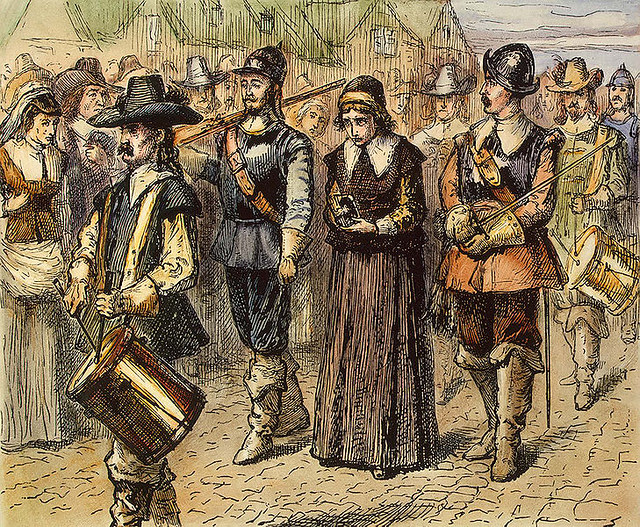 "Mary Dyer led to execution on Boston Common, 1 June 1660" (public domain, unknown artist)
May 21, 1669, Samuel Dyer, son of William & Mary Dyer and my 8th-great-grandfather (he married Anne Hutchinson, the granddaughter of Anne Marbury Hutchinson) is made Conservator of the Peace at Kingstown, RI.
May 21, 1820 Aucelia Ann [Angeline] Horton [27 2g] is born in Hector, Schuyler County, New York
"Mary Dyer led to execution on Boston Common, 1 June 1660" (public domain, unknown artist)
May 21, 1669, Samuel Dyer, son of William & Mary Dyer and my 8th-great-grandfather (he married Anne Hutchinson, the granddaughter of Anne Marbury Hutchinson) is made Conservator of the Peace at Kingstown, RI.
May 21, 1820 Aucelia Ann [Angeline] Horton [27 2g] is born in Hector, Schuyler County, New York
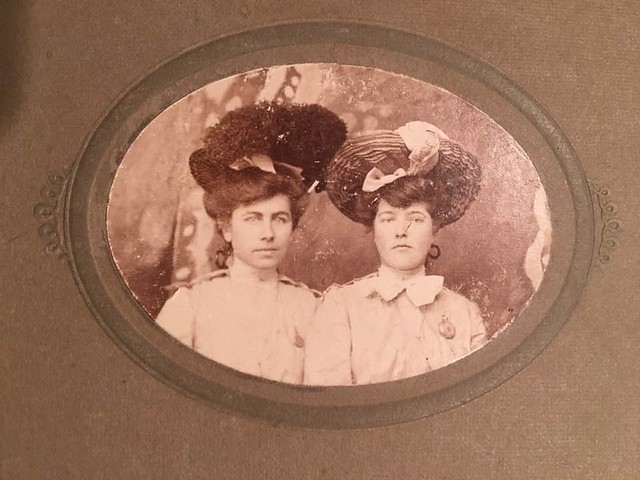 May 21, 1885 Nellie May Horn, grandaunt, sister of grandfather Frank Horn, is born. Nellie is on the left.
"Mary Dyer led to execution on Boston Common, 1 June 1660" (public domain, unknown artist)
May 21, 1669, Samuel Dyer, son of William & Mary Dyer and my 8th-great-grandfather (he married Anne Hutchinson, the granddaughter of Anne Marbury Hutchinson) is made Conservator of the Peace at Kingstown, RI.
May 21, 1820 Aucelia Ann [Angeline] Horton [27 2g] is born in Hector, Schuyler County, New York
May 21, 1885 Nellie May Horn, grandaunt, sister of grandfather Frank Horn, is born. Nellie is on the left.
Saturday, May 19, 2018
This Day, May 19, in Horn-Corey Family History
The world considers May 19 a special day this year because it is the day that Prince Harry married Meghan Markle, which happened just a few hours ago as I type this. But there are other important occurrences this date, connected to our family.
On May 19, 1973, Kenneth Leroy Horn (that’s me) and Peggy Louise Paul married in Concord, Contra Costa Co., California, at Full Gospel Church. Yes, today is our 45th anniversary.
On May 19, 1643, the New England Confederation is founded, joining the colonies of Plymouth, Connecticut, New Haven and Massachusetts Bay in a military alliance against the threats of Native Americans, the French and the Dutch. This confederation was significant to our ancestral families who lived in Plymouth and Massachusetts Bay—the Whites, Winslows, Hutchinsons & Dyers.
In 1305, our ancestor Count William the Good of Hainault married Jeanne De Valois. They are our 22nd great-grandparents.
 And way back in 804 “Alcuin of York, an English scholar who became an adviser to Charlemagne and the most prominent figure in the Carolingian Renaissance (the rebirth of classical learning under Charlemagne), die[d]. He also devised a handwriting system using both small and capital letters for easier reading.” —This Day in Church History, Christianity Today.
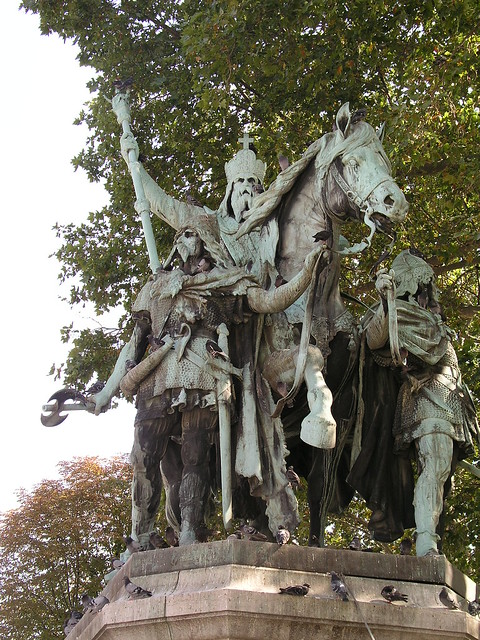
King Charlemagne (Charles the Great) is my 38th great-grandfather. (Photo taken by me in the plaza of Notre Dame Cathedral.)
And way back in 804 “Alcuin of York, an English scholar who became an adviser to Charlemagne and the most prominent figure in the Carolingian Renaissance (the rebirth of classical learning under Charlemagne), die[d]. He also devised a handwriting system using both small and capital letters for easier reading.” —This Day in Church History, Christianity Today.
King Charlemagne (Charles the Great) is my 38th great-grandfather. (Photo taken by me in the plaza of Notre Dame Cathedral.)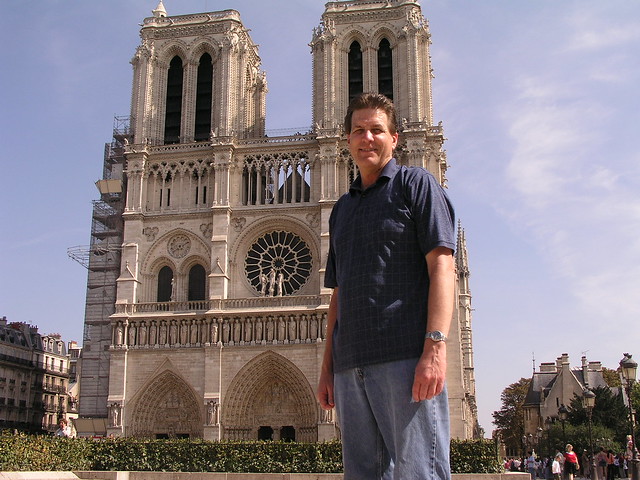
And way back in 804 “Alcuin of York, an English scholar who became an adviser to Charlemagne and the most prominent figure in the Carolingian Renaissance (the rebirth of classical learning under Charlemagne), die[d]. He also devised a handwriting system using both small and capital letters for easier reading.” —This Day in Church History, Christianity Today.
King Charlemagne (Charles the Great) is my 38th great-grandfather. (Photo taken by me in the plaza of Notre Dame Cathedral.)
Friday, May 18, 2018
British Loyalists Flee to Canada Following the Revolutionary War, Including Some of My Ancestors
I love history and genealogy. Here’s a bit of both concerning this date in history.
It had been one of history’s most surprising upsets. The underdog, upstart American Colonists had recently stunned the mighty British Empire and won their freedom. For those who had not supported the revolutionaries, there was upheaval.
 On May 18, 1783, the British transport ship Union docked with the fleet transporting the first group of United Empire Loyalists to leave the newly created United States of America for friendlier British territories. These “Tories”—those faithful to the British Crown during the 8-year American Revolutionary War—had forfeited their land and much of their possessions to the victorious American Patriots (called Rebels, Traitors, or worse by the British). Most Loyalists ended up in nearby Canada, the first of them debarking at Parrtown, Saint John, Nova Scotia, which is now New Brunswick.
My ancestor Gideon Corey was among those aboard the Union.
It had been just 3 months since the War for Independence had been ended with the signing of the Treaty of Paris. Throughout most of the War, New York had been under British control, and this was where the majority of Loyalist evacuees were from.
The Crown repaid their loyalty by granting them land in unsettled regions. They became pioneers in the area of Nova Scotia that became New Brunswick one year after their arrival.
Gideon Corey, born in Rhode Island, was just 19 when the Colonies officially declared their Independence and 26 (and single) when he became a Canadian resident.
He soon married Abigail Clarke. Abigail’s ancestor Joseph Clarke is my eighth-great-grandfather. It is his brother, John Clarke (1609-1676), who is a significant historical figure. He was a medical doctor and founding pastor of the First Baptist church in Providence, as well as co-founder of Rhode Island and author of its groundbreaking charter. The charter asserted “that no person within the said colony, at any time hereafter shall be any wise molested [harassed], punished, disquieted, or called in question, for any differences in opinion in matters of religion, and do not actually disturb the civil peace of our said colony.” But Abigail was of a different political inclination than her famous relative.
Gideon and Abigail Corey, my fourth-great-grandparents, ultimately settled a British land grant in a remote portion of what is now Queens County. Here they raised a large family, including my third-great-grandfather Stephen Corey (born 1797). (Corey is my mother’s maiden name.)
On May 18, 1783, the British transport ship Union docked with the fleet transporting the first group of United Empire Loyalists to leave the newly created United States of America for friendlier British territories. These “Tories”—those faithful to the British Crown during the 8-year American Revolutionary War—had forfeited their land and much of their possessions to the victorious American Patriots (called Rebels, Traitors, or worse by the British). Most Loyalists ended up in nearby Canada, the first of them debarking at Parrtown, Saint John, Nova Scotia, which is now New Brunswick.
My ancestor Gideon Corey was among those aboard the Union.
It had been just 3 months since the War for Independence had been ended with the signing of the Treaty of Paris. Throughout most of the War, New York had been under British control, and this was where the majority of Loyalist evacuees were from.
The Crown repaid their loyalty by granting them land in unsettled regions. They became pioneers in the area of Nova Scotia that became New Brunswick one year after their arrival.
Gideon Corey, born in Rhode Island, was just 19 when the Colonies officially declared their Independence and 26 (and single) when he became a Canadian resident.
He soon married Abigail Clarke. Abigail’s ancestor Joseph Clarke is my eighth-great-grandfather. It is his brother, John Clarke (1609-1676), who is a significant historical figure. He was a medical doctor and founding pastor of the First Baptist church in Providence, as well as co-founder of Rhode Island and author of its groundbreaking charter. The charter asserted “that no person within the said colony, at any time hereafter shall be any wise molested [harassed], punished, disquieted, or called in question, for any differences in opinion in matters of religion, and do not actually disturb the civil peace of our said colony.” But Abigail was of a different political inclination than her famous relative.
Gideon and Abigail Corey, my fourth-great-grandparents, ultimately settled a British land grant in a remote portion of what is now Queens County. Here they raised a large family, including my third-great-grandfather Stephen Corey (born 1797). (Corey is my mother’s maiden name.)
Friday, May 11, 2018
Who Is Fort McHenry Named for?
James McHenry, Secretary of War
American Minute with Bill Federer (reprinted with permission)
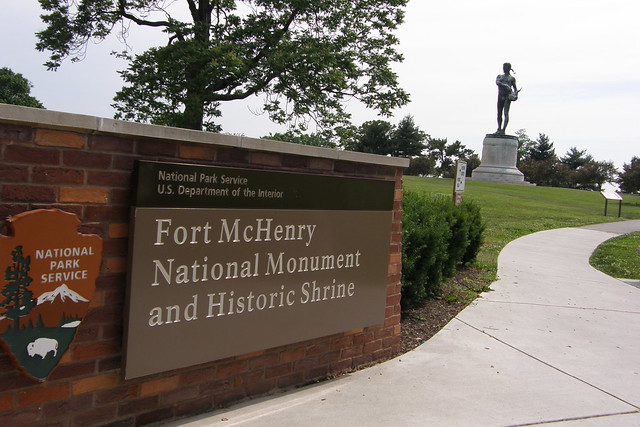
The Star-Spangled Banner was written while the
British bombed Fort McHenry, named after Secretary of War James McHenry.
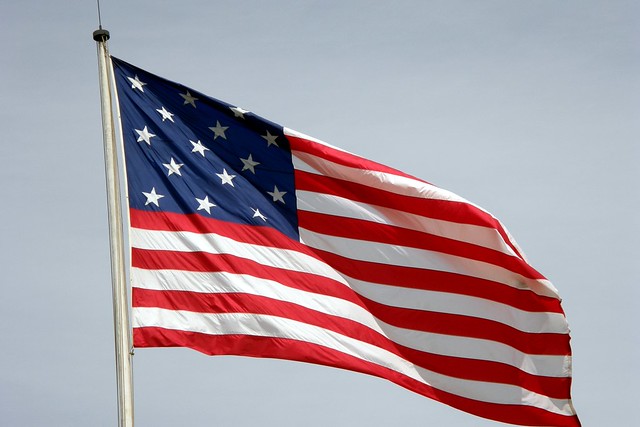
Dr. James McHenry served as a surgeon during the Revolutionary War.
He was taken prisoner by British when General William Howe captured Fort
Washington, New York.
Paroled in 1777, James McHenry was at the Battle of Monmouth, then became
an aide to General George Washington in 1779.
On September 24, 1780, James McHenry was riding
with General Washington and Major-General Lafayette to inspect the defenses of West
Point.
A breakfast was planned that morning with the
fort's commanding officer, General Benedict Arnold.
Being delayed, Washington sent McHenry ahead to
give his apologies to Benedict Arnold.
McHenry arrived only to find confusion in the
fort, as Arnold had planned on betraying West Point and capturing General
Washington.
Just moments before, Arnold's treasonous plot to
betray America's military had been discovered, with the British spy, John
Andre, having a map of West Point hidden in his boot.
Arnold fled to the British ship, Vulture.
On May 8, 1783, Yale President Ezra Stiles
stated:
"A providential miracle at the last minute detected the treacherous
scheme of traitor Benedict Arnold, which would have delivered the American
army, including George Washington himself, into the hands of the enemy."
The Continental Congress issued a Day of
Thanksgiving, October 18, 1780: "In the late remarkable interposition of
His watchful providence, in the rescuing the person of our Commander-in-Chief
and the army from imminent dangers, at the moment when treason was ripened for
execution."
After the War, Dr. James McHenry was elected to
the Maryland Legislature and sent as a delegate to the Continental Congress.
He was at the Constitutional Convention and signed the U.S. Constitution.
George Washington wrote to James McHenry, July
31, 1788:
"I earnestly pray that the Omnipotent Being,
who has not deserted the cause of America in the hour of its extremest hazard,
may never yield so fair a heritage of freedom a prey to anarchy or
despotism."
James McHenry served as Secretary of War under Presidents George Washington
and John Adams.
He transitioned western military posts from Great
Britain's control to the United States under the Jay Treaty.
He advised the Senate against reducing military
forces.
James McHenry is credited with establishing
the Department of the Navy, based on his March 8, 1798, recommendation that
the "War Department should be assisted by a commissioner of marine."

As Secretary of War, he added his voice to those
demanding a military academy to train officers, laying the groundwork for the
United States Military Academy at West Point.
Charles Carroll, a Signer of the Declaration of
Independence, wrote to James McHenry, November 4, 1800:
"Without morals a republic cannot subsist
any length of time; they therefore who are decrying the Christian religion,
whose morality is so sublime and pure and which insures to the good eternal
happiness, are undermining the solid foundation of morals, the best security
for the duration of free governments."
After public service, former Secretary of War
James McHenry became President of the first Bible Society in Baltimore,
Maryland, stating in 1813:
"Neither ... let it be overlooked, that
public utility pleads most forcibly for the general distribution of the Holy
Scriptures. The doctrine they preach, the obligations they impose, the
punishment they threaten, the rewards they promise, the stamp and image of
divinity they bear, which produces a conviction of their truths, can alone
secure to society, order and peace, and to our courts of justice and
constitutions of government, purity, stability and usefulness.
In vain, without the Bible, we increase penal
laws and draw intrenchments around our institutions. Bibles are strong
intrenchments. Where they abound, men cannot pursue wicked courses, and at the
same time enjoy quiet conscience ..."
McHenry continued: "Consider also, the rich
do not possess aught more precious than their Bible, and that the poor cannot
be presented by the rich with anything of greater value. Withhold it not from
the poor.
It is a book of councils and directions, fitted
to every situation in which man can be placed. It is an oracle which reveals to
mortals the secrets of heavens and the hidden will of the Almighty ..."
James McHenry concluded: "It is an estate,
whose title is guaranteed by Christ, whose delicious fruits ripen every season,
survive the worm, and keep through eternity. It is for the purpose of
distributing this divine Book more effectually and extensively among the
multitudes, whose circumstances render such a donation necessary, that your
cooperation is most earnestly requested."
After his death on MAY 3, 1816, James McHenry's
wife, Margaret "Peggy" McHenry, wrote: "Here we come to the end
of a life of a courteous, high-minded, keen-spirited, Christian gentleman. He
was not a great man, but participated in great events and great men loved him,
while all men appreciated his goodness and purity of soul. His highest titles
to remembrance are that he was faithful to every duty and that he was the
intimate and trusted friend of Lafayette, of Hamilton, and of Washington."

American Minute is a registered trademark of
William J. Federer. Permission is granted to forward, reprint, or duplicate,
with acknowledgment.
Thursday, May 10, 2018
Carroll County Civil War Draft Order
From
History of Carroll County.
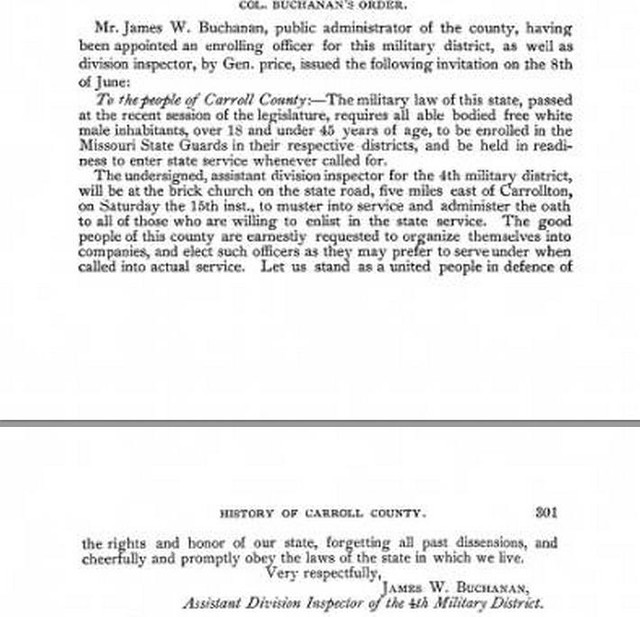
This is the order that conscripted John G. Addis, a native of Ireland with a family, into the Missouri State Guard, eventuallly serving under Confederate General Sterling Price. He was captured at the Battle of the Big Blue near Kansas City, and died at the notorious Camp Morton in Indiana. He had no reason to fight for slavery. I'm convinced this draft order is the only reason he fought—and died—for the Confederacy. I'm sure many others were also in his shoes. He was my great-great grandfather [No. 22].
Subscribe to:
Posts (Atom)